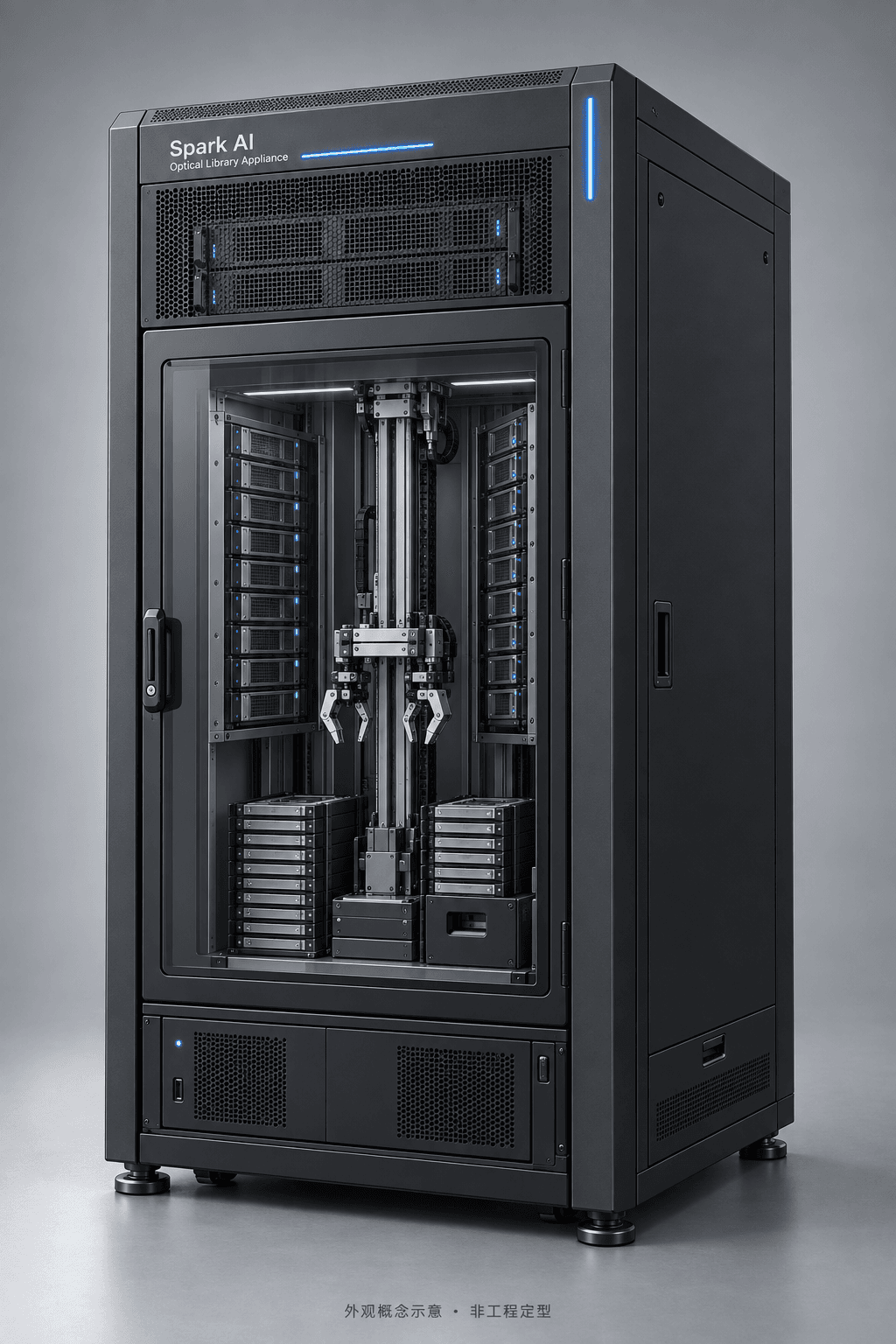
Benchmark plan · Results pending validation
Agent Memory TCO Benchmark
Compare three storage configurations with the same workflow to evaluate cost, retrieval, answer quality, state freshness and energy. No measured results are published yet; no savings percentage or winning medium is assumed.
All SSD
Results pending validation
SSD + HDD
Results pending validation
SSD + HDD + Optical Archive
Results pending validation
Five measurable outcomes
- Cost per 1,000 tasks
- Allocated total cost / attempted tasks × 1,000. Include amortized hardware, software, operation, model/API, energy, migration and archive recovery costs over a disclosed observation period; report completion and failure rates alongside cost.
- Retrieval latency
- P50 / P95 in milliseconds, from retrieval request to verified context availability. Report cache hits, misses and archive reactivation separately.
- Answer accuracy
- Correct answers / evaluated tasks against a fixed reference set and scoring rubric. Use the same evaluator and include citation-grounding checks.
- Stale-state rate
- Tasks using expired or superseded state / evaluated state-dependent tasks. Define freshness windows and authoritative state versions before each run.
- Energy consumption
- Metered kWh per 1,000 tasks plus idle watts over the same observation period. Disclose device/system boundaries and include archive write, read and reactivation energy.
Fair comparison and tiering rules
Hold dataset/version, model/settings, prompts, workflow, compute, concurrency, usable capacity, redundancy and retention requirements constant. Test cold and warm cache separately; repeat runs and disclose configuration, sample size, duration and variation. Storage layout and tiering policy are the comparison variables.
Set acceptance thresholds for accuracy, freshness, latency and recovery before testing. Decide what can move to a lower tier only after these thresholds and permission, retention and integrity constraints are met, using measured cost and energy. Active state and strict low-latency data are not automatically archived: the benchmark does not assume all cold data belongs on optical media.